Harmonic Solution for Medium frequency furnace

Systematically analyze the 5th, 7th, 11th, and 13th characteristic harmonics and reactive power impacts generated by medium-frequency furnaces. Compare mainstream solutions, including passive filters, active power filters (APF), dedicated furnace filters, and multi-pulse rectification, providing selection guidance to improve power factor and power supply stability.

Overview of Harmonic Mitigation for Medium-Frequency Induction Furnaces

As one of the most numerous and polluting sources of harmonics in the industrial sector, the need for harmonic control of intermediate frequency furnaces is already a consensus in the industry. However, in practice, the harmonic pollution problem is far from being fundamentally solved.

On the one hand, harmonic mitigation technologies appear mature—passive filters, active filters, multi-pulse rectification, and other solutions have all seen engineering applications.

On the other, however, most enterprises still commonly face practical difficulties during actual mitigation, such as mismatches between solutions and operating conditions, lack of proper measurement and diagnostics, and high maintenance costs. These issues frequently lead to “incomplete mitigation” or even “worse results after treatment.”

Product or Solution Inquiry
Industry Pain Points
While technical solutions are mature, enterprises still face multiple practical challenges in actual harmonic mitigation.
  • 1

    Mitigation lags behind construction – mostly reactive measures

    Most of medium-frequency furnaces were built and commissioned long ago, so harmonic mitigation can only be implemented as a retrofit after the fact, failing to address the root cause and its effectiveness is limited by existing power grid conditions.
  • 2

    Passive solutions carry resonance risks – hidden hazards hard to predict

    Grid impedance changes with operating conditions. Even a well‑designed LC filter may trigger resonance due to subsequent alterations in grid structure, which can amplify harmonics and even damage equipment.
  • 3

    Simplified measurement and diagnostics-selection lacks a solid basis

    Many enterprises skip professional harmonic spectrum measurements to save costs and directly adopt generic solutions, resulting in filter capacities that do not match actual load.
  • 4

    Balancing cost and effectiveness is difficult – selection tends to extremes

    Passive solutions are cheaper but poorly adaptable; active solutions perform well but are costly and complex to maintain. Enterprises often choose incorrectly based on low-price procurement logic, only to face even higher rework costs later.
Comparison of Mainstream Harmonic Mitigation Solutions for Medium-Frequency Induction Furnaces
The core approach to harmonic mitigation for medium-frequency induction furnaces can be summarized into two major directions: "active prevention" and "passive treatment." We have sorted out the current mainstream treatment plans.
  • Passive Harmonic Filter
    Composed of capacitors and reactors, it provides a low-impedance path for filtering specific harmonics (such as the 5th and 7th harmonics).
    Advantages

    With simple structure, low cost, also with reactive power compensation function.

    Limits

    Only worked for fixed order, resonance with the system and lead to equipment failure may caused. Filtering effect easily affected by the system impedance.

    Scenarios Application

    Suitable for small to medium capacity applications with stable loads, fixed harmonic orders (such as older 6-pulse rectifiers) and high cost sensitivity.

  • Active Harmonic Filter
    Harmonics are dynamically canceled by generating a reverse compensation current in real time using power electronic devices.
    Advantages

    Dynamically tracks and compensates for all harmonics (2nd-50th), with fast response and unaffected by system impedance.

    Limits

    Cost is relatively high,limited capacity of single-unit, relative complex maintenance.

    Scenarios Application

    Precision machining or special metallurgical applications requiring high power quality, complex and variable harmonics, and suppression of voltage flicker.

  • Multi-phase/multi-pulse rectification technology
    By increasing the rectified pulse number (such as 12 pulses or 24 pulses) using a phase-shifting transformer, specific order harmonics can be eliminated at the source.
    Advantages

    Active control reduces harmonic generation at its source, yielding significant results.

    Limits

    High equipment investment, large transformer size, and complex modification.

    Scenarios Application

    Large-capacity new intermediate frequency furnace projects can be combined with high-voltage side filter compensation to achieve comprehensive benefits.

What Is a Dedicated Filter for Medium-Frequency Induction Furnaces?

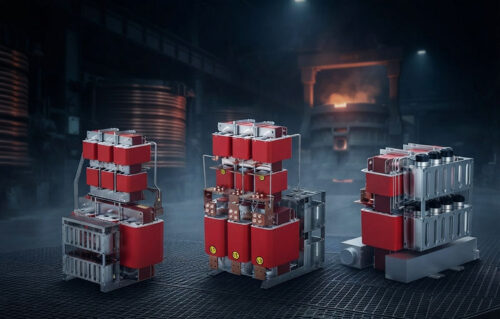
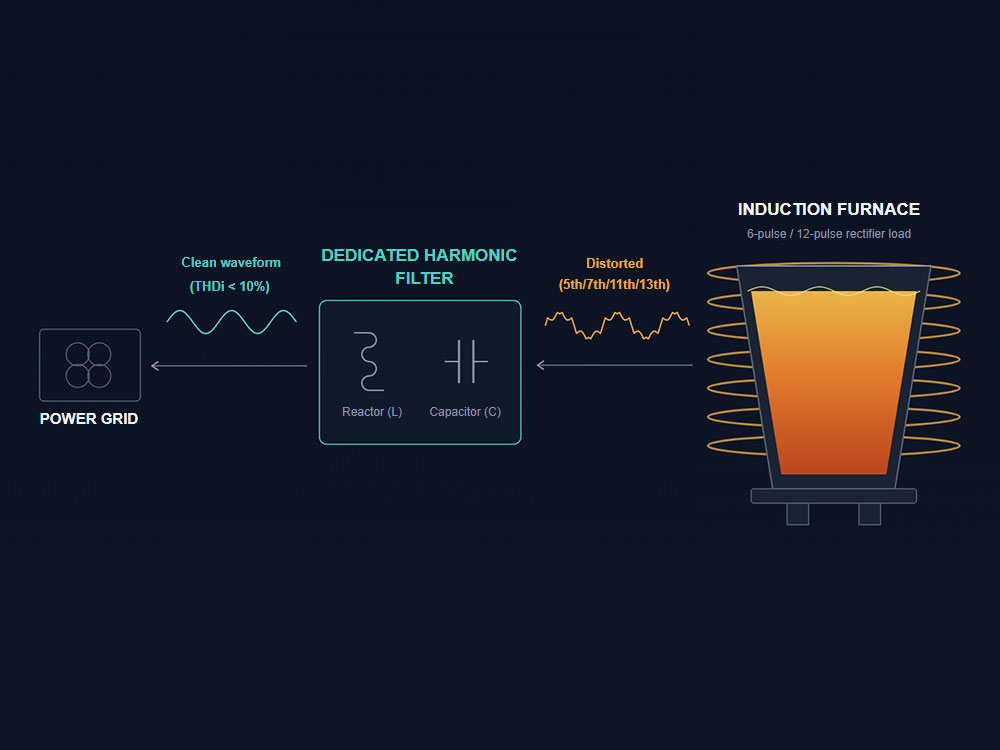
A dedicated medium-frequency furnace filter is a power quality management device designed specifically for the power supply system of a medium-frequency induction furnace. It is primarily used to suppress harmonic currents generated by nonlinear loads such as rectifiers and inverters during furnace operation, reducing grid harmonic pollution, improving the power factor, and minimizing energy loss and equipment heating.

The filter consists of passive filtering components, including reactors and capacitors. By leveraging the resonance characteristics at specific frequencies, it absorbs and attenuates target harmonics, ensuring stable operation of the power supply system. This enhances the operating efficiency of medium-frequency furnace equipment and improves grid compatibility. Such filters are widely used in industrial applications involving medium-frequency induction heating equipment, including metallurgy, foundry, and heat treatment.

Check out our products

How to Choose a Suitable Mitigation Solution
The selection of a solution should not be a "one-size-fits-all" approach; instead, it requires a systematic comparison of technical and economic feasibility based on actual site operating conditions.
  • Precision testing comes first – understanding harmonic characteristics is the prerequisite for selection.

    Before designing the mitigation solution, the following basic tasks must be completed:

    1.1. Continuously monitor the power grid using professional power quality analysis equipment.

    1.2. Accurately obtain key parameters such as harmonic spectrum distribution (harmonic orders and their content percentages) and reactive power fluctuation curves.

    The above measured data is the core basis for solution design and should not be replaced by empirical estimations or comparisons with similar projects.

  • Match the appropriate mitigation technology based on harmonic characteristics.

    Different harmonic characteristics correspond to different technical approaches:

    2.1. If harmonics are mainly fixed characteristic harmonics such as 5th, 7th, 11th, 13th, etc., and the load is relatively stable, passive filters have a significant economic advantage and should be prioritized.

    2.2. If harmonic components are complex and variable, or if voltage flicker suppression is required, an APF or SVG+FC hybrid solution is preferable to achieve better dynamic response capability.

    2.3. For new large-capacity projects, 12/24-pulse rectification technology can be given priority to reduce harmonic generation at the source.

  • Pay attention to engineering details to ensure system safety and long-term reliability.

    Different technical approaches have different emphases during engineering implementation:

    3.1. Passive filter design requires precise calculation of the reactance ratio (e.g., 5%, 7%, etc.) and capacitor rated voltage, with reasonable margins reserved, to avoid the risk of resonance with the system.

    3.2. For active equipment selection, redundancy configuration of key components should be considered, with special attention to the brand reliability and thermal design of core devices (such as IGBT modules).

Typical Case Reference

This case demonstrates the practical application effectiveness of a dedicated filter for medium-frequency induction furnaces in mitigating characteristic harmonics and suppressing reactive power impacts.

Issues to be addressed

A foundry enterprise operates a 5-ton medium-frequency induction furnace with 6-pulse rectification. During operation, significant 5th, 7th, 11th, and 13th harmonics are generated, accompanied by severe reactive power impacts (short-term peak up to 2000 kvar), which cause grid voltage flicker and pose certain risks to the safe and stable operation of the power supply system.

Mitigation approach

To address the above issues, the enterprise adopted a dedicated filter solution designed for medium‑frequency induction furnaces.

Mitigation results

After commissioning, the improvement in key operating parameters is as follows:

1. Harmonic mitigation: The 5th, 7th, 11th, and 13th harmonic currents on the high-voltage side were all reduced to within the limits specified by national standards.

2. Power factor: Increased from 0.89 before commissioning to a stable value above 0.95.

3. Voltage flicker: The maximum grid voltage fluctuation was effectively suppressed to within 200 V, ensuring the safety of equipment operation.

Summary

This case demonstrates that the dedicated filter for medium-frequency induction furnaces offers good engineering adaptability in mitigating characteristic harmonics and suppressing reactive power impacts, and is particularly suitable for applications where harmonic characteristics are relatively fixed and load fluctuations are within a controllable range.

Conclusion

Medium-frequency induction furnaces are among the largest and most severe harmonic sources in industrial power distribution systems. The characteristic harmonics (5th, 7th, 11th, 13th, etc.) and intense reactive power impacts they generate have long threatened grid equipment safety, metering accuracy, and power supply stability.

In practical mitigation, the industry commonly faces a series of actual challenges: lack of proper measurement and diagnostics, mismatches between solutions and actual operating conditions, resonance risks with passive filters, and difficulty balancing cost and performance. As a result, harmonic mitigation at many enterprises remains stuck at the level of “reactive afterthoughts that address symptoms rather than root causes.”

To address these industry-wide issues, our company has launched a dedicated filter for medium-frequency induction furnaces. Specifically designed for 6-pulse and 12-pulse rectification characteristics, it is easy to select, requires no on-site commissioning or maintenance, and effectively filters out non-characteristic harmonics while suppressing reactive power impacts. It serves as a reference option for medium-frequency furnace users in their harmonic mitigation efforts.

Related Products
We have applied many products in the "harmonic-solution-for-medium-frequency-furnace" solution